

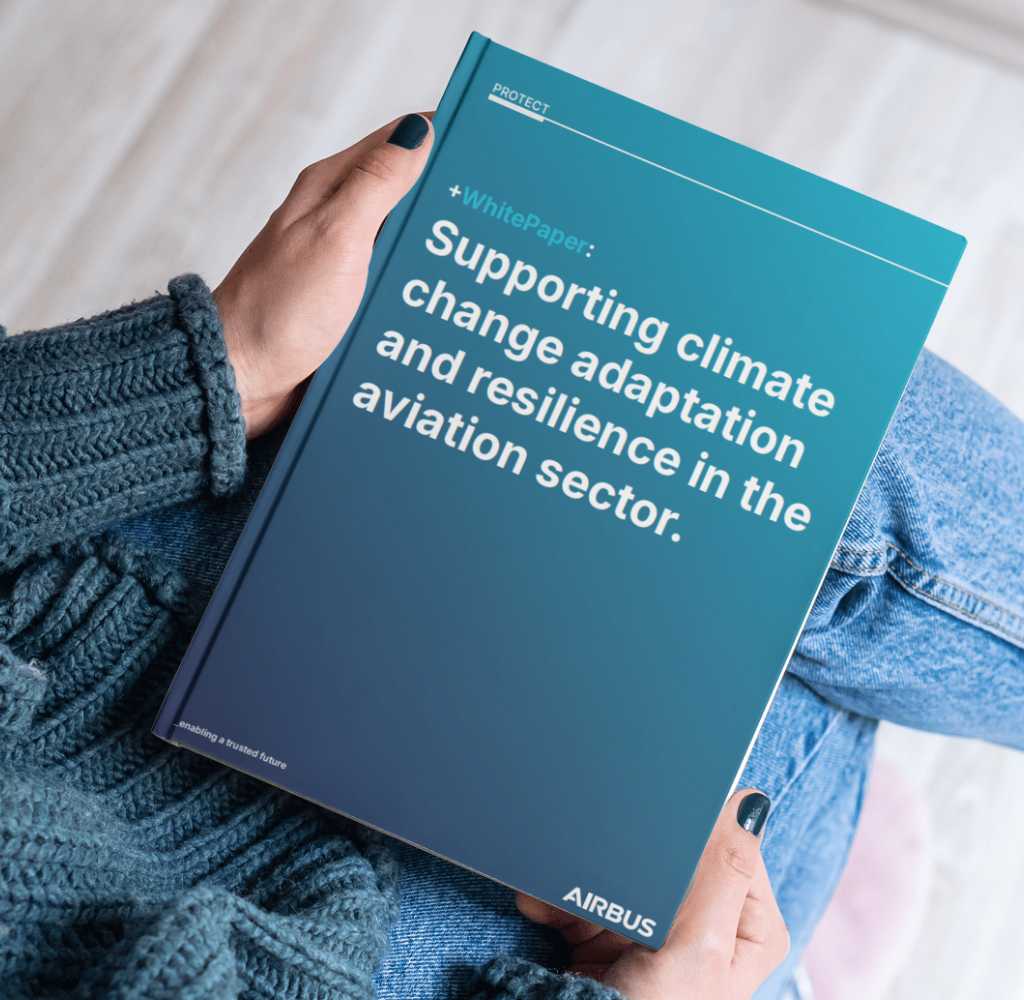
Supporting climate change adaptation and resilience in the aviation sector
Why climate adaptation is critical for aviation
While reducing emissions remains a central goal for the industry, adaptation to existing and future climate shifts has received less attention. Yet, the aviation sector has an especially close relationship with weather phenomena, and aircraft operate in the higher troposphere where weather disruptions occur.
From aircraft designed for decades of service to long-lived airport infrastructure, the industry must employ long-term foresight now. A localised event, such as an intense storm or extreme heatwave, can trigger cascading delays and operational disruptions across the global, interconnected air transport network.
Navigating unique industry challenges
The Airbus Protect Sustainability Team conducted a targeted strategic study on U.S. airport infrastructure to understand how critical transportation nodes will be functionally impacted by future climate trajectories.
Our Data-Driven Approach
At Airbus Protect, we use a structured methodology that combines historical data analysis with predictive climate modeling to provide actionable foresight.
- Historical Analysis: Quantifying past disruptions, such as the 14% increase in weather-related cancellations (WRC) at the top 30 U.S. airports over the last decade.
- Future Modeling: Utilising CMIP6 emission scenarios to project how shifting wind patterns, intense heatwaves, and extreme precipitation will impact future operations.
- Risk Assessment: Developing airport-specific risk scores to help stakeholders move past reactive measures toward robust, proactive adaptation strategies.
What you will find in this White Paper:
- Impact Overview: A deep dive into how climate change affects airworthiness and operational safety.
- Sector-Specific Challenges: Tailored insights for airports, airlines, and Original Equipment Manufacturers (OEMs).
- Climate Modeling 101: An overview of our methodology, from the basics of climate modelling to advanced climate data analysis
- U.S. Case Study: A comprehensive risk map of the top 30 U.S. airports and their future vulnerability levels.
- Strategic Recommendations: How to identify thresholds to trigger adaptation plans and future-proof your operations.
Build lasting resilience with Airbus Protect
A well-structured adaptation plan is not only crucial to safeguard business resilience but also to maintain long-term competitive advantage. Airbus Protect combines scientific precision with deep industry knowledge to empower aviation stakeholders to make informed, financially sound decisions in a changing climate.