
On 2026-07-21
by Morian Kassimi and Rémi Gazquez

Sovereign-by-Design: Pillar of Modern Digital Sovereignty

Summary

“Data Transfer” or the Risk of Digital Exile

In a world where data has become the central strategic asset for societal prosperity and economic competitiveness, a fundamental question arises: who truly holds the keys to our digital future?

For a long time, data utility was prioritised at the cost of data control. Today, hosting sensitive data—whether healthcare, industrial, or sovereign—on foreign infrastructures exposes organisations to a genuine “digital exile.” This risk is no longer merely theoretical: the application of extraterritorial legislation (such as the U.S. CLOUD Act) allows third-party authorities to access strategic digital assets. This situation creates a power asymmetry where stakeholders fear a loss of control and a major competitive disadvantage. 

Confronted with these threats, the concept of data sovereignty emerges not as a protectionist stance, but as an instrument of freedom. It is defined as the self-determination of individuals and organisations regarding the use of their own data. 

For the cybersecurity architect, sovereignty goes beyond simple legal compliance; it becomes a technical design challenge (Sovereign by Design). It involves building trusted environments where both the provider and the consumer can monitor and control every action performed on their assets. The challenge is to shift from a state of forced dependency to genuine autonomy, where data remains under the exclusive control of its creator, from its creation to its destruction.


Data Residency vs Data Sovereignty

For the general public, the notions of residency and digital sovereignty often seem interchangeable. However, in information systems architecture, they describe radically different strategic realities that every expert must distinguish to ensure the true protection of digital assets.

Data Residency

Data residency is defined primarily as a geographic and legal constraint. It mandates that data, once converted into digital form, must be physically stored and processed within the borders of a specific country. The core objective of this approach is to ensure that data is subject exclusively to the laws and regulations of that particular nation. However, for the architect, residency is a necessary but often insufficient condition. The limitation of this model lies in its inability to protect data against extraterritorial jurisdictions: storing data on a local server is futile if the infrastructure is operated by an entity subject to foreign laws, such as the U.S. CLOUD Act, which allows data access by a third party without the owner’s consent.

Data Sovereignty

Data sovereignty, conversely, is a capacity for self-determination that goes beyond the simple question of physical location. It concerns the exclusive and autonomous control exercised by an individual or an organisation over the use of their digital asset. Where residency is similar to a matter of “land registry” or soil, sovereignty is a matter of the “lock” and global governance. It relies on the implementation of Usage Control, which differs from traditional access control. While access control merely verifies entry into the system, sovereignty requires the ability to specify and enforce strict usage conditions even after access has been granted. In this vision, the architect enables the owner to define precise rules, such as prohibiting file copying or limiting its retention period to 24 hours, thereby guaranteeing total mastery across the entire value chain.
FeatureData ResidencyData Sovereignty
FocusPhysical Location (Geolocation)Control and Autonomy (Self-determination)
NatureLegal/Geographic constraintTechnical and contractual capability
ActorThe legislatorThe Data Provider (Owner)
Risk CoveredLocal regulatory non-complianceLoss of control and unauthorised exploitation

In summary, while data residency focuses on geographic location under the protection of the legislator to cover regulatory non-compliance risks, sovereignty aims for technical and contractual autonomy. It places the data owner at the center of the chessboard to prevent loss of control and unauthorised exploitation. For the cybersecurity architect, residency is merely the foundation of a building for which sovereignty constitutes the indispensable armor. Without robust usage control mechanisms and trusted infrastructures, residency remains an illusion of security within the complexity of a hybrid cloud world.


The Challenges

The implementation of true data sovereignty faces structural obstacles that information systems research identifies as technical, legal, and conceptual challenges. For the architect and the citizen, understanding these barriers is the first step toward building resilient solutions.

Unlike traditional physical goods, data possesses inherent characteristics that defy classical control methods. It can be duplicated infinitely with near-zero reproduction costs and no loss of quality, making the notion of “possession” particularly complex. Furthermore, there is no single definition or legally binding concept of data ownership in current research, as data cannot be easily classified as either private goods or common goods. This immateriality creates a grey area where control is lost as soon as access is granted, unless mechanisms are in place to track the data through its successive transformations within the value chain.

For institutions and economic players, sovereignty has become a vital success factor in deciding how to use data as an economic asset. However, current dependence on monopolistic platforms creates an asymmetry of information and power, where stakeholders hesitate to share data for fear of competitive disadvantage or unauthorised exploitation. This challenge impacts particularly public services: if a country lacks effective means to control its information, it risks becoming partially dysfunctional. There is, therefore, a permanent tension between the necessity of sharing data to innovate and the imperative to protect the organisation’s strategic interests.

The final challenge, and not the least important for the architect, lies in the technical complexity of sharing environments. Within the framework of the Cloud or the Internet of Things (IoT), it is often impossible to know with certainty which law applies to stored information or which country it transits through. This legal uncertainty is reinforced by persistent terminological ambiguity in research, where stakeholders do not always share the same understanding of the concept of sovereignty. Without holistic reference models or standardised infrastructures, implementation attempts often remain isolated, limiting the creation of truly sovereign and trustworthy data ecosystems.


Responses and Strategies

The implementation of data sovereignty cannot rely solely on promises; it requires a combination of legal frameworks, technical standards, and robust software architectures. The goal is to create environments where data sharing no longer signifies a loss of control, but rather a secure collaboration.

To address the opacity of current systems, major European initiatives such as the International Data Spaces Association (IDSA) and Gaia-X have defined standards for a sovereign data infrastructure. These models are based on interoperability and decentralisation, allowing stakeholders to connect without depending on a dominant central authority. By using standardised connectors, companies can exchange digital assets while ensuring that the usage rules defined at the source are respected by the recipient. This “data spaces” approach allows for the pooling of costs and fosters joint innovation without sacrificing the security of sensitive information.

One of the pillars of this strategy lies in transforming legal agreements into technically enforceable policies. Traditional contracts, which are often difficult to monitor manually, are supplemented by smart contracts or semi-automated usage policies that govern data flows. These digital agreements precisely determine the rights and obligations of the parties, including access conditions, retention periods, and authorised processing purposes. For the architect, this means integrating policy management layers that validate and execute the contract terms at every stage of the data lifecycle.

At the heart of the technical arsenal lies Usage Control (UC), which represents the necessary evolution from simple access control. While access control stops once the door is opened, UC maintains continuous oversight of the data, even after it has left the provider’s perimeter. Techniques such as data watermarking, advanced encryption, or decentralised identities allow for the real-time verification of asset integrity and participant identity. These tools ensure that only trusted actors, operating within certified environments, can manipulate digital assets in accordance with previously negotiated agreements.


Sovereign-by-Design

The “Sovereign by Design” approach requires considering sovereignty not as a compliance layer added as an afterthought, but as an inherent property of the information system. This vision is based on a rigorous conceptual model that places the data asset at the center of an ecosystem of regulated interactions. For the architect, this means orchestrating seven fundamental aspects: the data asset itself, the roles of provider and consumer, contractual agreements, lifecycle activities, technical infrastructure, and finally, the pillar of trust.

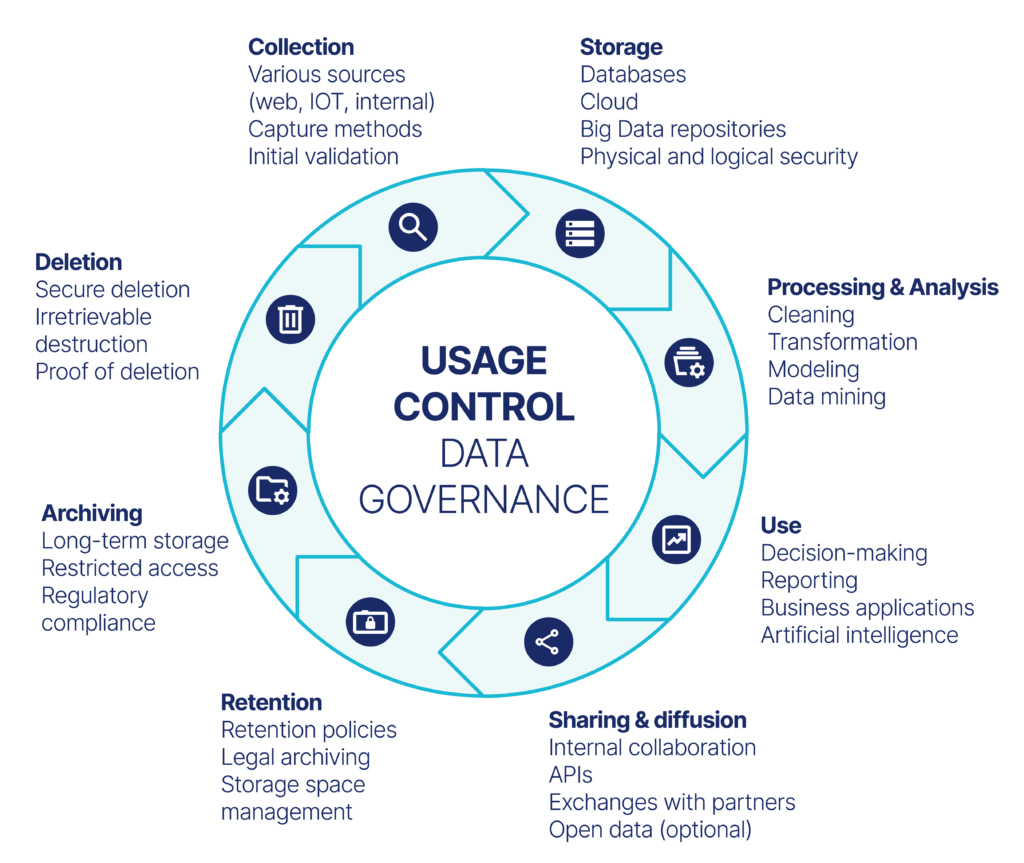
In a sovereign architecture, protection must follow the data from creation to destruction, through storage, sharing, and archiving. The transition from Access Control (AC) to Usage Control (UC) is the major technological change here: it involves ensuring that the conditions negotiated in the contractual agreement are technically enforced even after the data has been transmitted to the consumer. The infrastructure must therefore be capable of continuously validating and executing policies, using enforcement mechanisms to prevent any unauthorised or deviant use of the asset.

“Sovereign by Design” aims to reduce the minimum level of trust required between potentially unknown parties within complex ecosystems. To achieve this, the architect relies on a data infrastructure—often decentralised and based on standards such as those from IDSA or Gaia-X—which acts as a technically trusted third party. This infrastructure ensures the transparency of actions through identity management and the semi-automated validation of digital contracts. By transforming legal obligations into executable technical rules, we create an environment where sovereignty is no longer a mere intention, but a mathematical and software certainty.

By adopting this vision, organisations can finally balance the economic opportunities of data sharing with the protection of their strategic interests. The “Sovereign by Design” model provides stakeholders with the necessary instruments to navigate a global data economy without suffering the competitive disadvantages associated with a loss of control. For the cybersecurity architect, the success of this approach lies in its ability to make sovereignty operational, thereby transforming data into an asset that is truly controlled and valued throughout its digital life.

Sovereignty by design

Conclusion

At the end of this analysis, one thing becomes clear: data sovereignty is not an option, but the very foundation of a trustworthy digital economy. As illustrated by the lifecycle presented above, the transition from passive management to a proactive architecture—Sovereign by Design—requires placing usage control at the heart of every interaction.

For the architect and the decision-maker alike, the challenge of 2026 no longer lies solely in protecting against unauthorised access, but in guaranteeing that data usage remains compliant with the creator’s intent, even after it has been shared. By integrating automated digital contracts and infrastructures capable of executing these rules, we move from blind trust to genuine technical autonomy.

In the face of the power of AI models and the globalisation of data flows, choosing sovereignty means choosing to remain master and commander regarding one’s assets, thereby ensuring strategic independence and sustainable innovation.


Bibliography

Banse, C. (2021). Data sovereignty in the cloud – Wishful thinking or reality? Conference on Computer and Communications Security, 153-154.

Hummel, P., Braun, M., Tretter, M., & Dabrock, P. (2021). Data sovereignty: A review. Big Data & Society, 8(1).

Jarke, M., Otto, B., & Ram, S. (2019). Data sovereignty and data space ecosystems. Business & Information Systems Engineering, 61(5), 549-550.

Nagel, L., & Lycklama, D. (2021). Design principles for data spaces – Position paper.

von Scherenberg, F., Hellmeier, M., & Otto, B. (2024). Data Sovereignty in Information Systems. Electronic Markets, 34:15.

  • Share