
On 2026-06-22
by Manon NARETTO, Agathe VIRFEU, Julie LESUR

Replacement of Black Chromium – Qualification of a REACh compliant alternative

Replacement of Black Chromium - Qualification of a REACh compliant alternative
Summary

Context: Protecting Tungsten Weights

Black chromium is a specific plating applied to tungsten substrates (heavy metal cores) used as balancing weights. These weights are critical for stabilising helicopter rotors and reducing vibrations. 

While the coating is non-decorative (matte black) and set up for anti-reflective applications, its primary function here is anti-corrosion. It is widely used in aeronautics, and for military applications. 

The tungsten substrates on which it is applied are highly sensitive to oxidation and, more specifically, to galvanic corrosion, an electrochemical reaction that eats away at metal when two different metals are in contact in the presence of an electrolyte like moisture.
 

Therefore, these parts require robust surface protection to ensure their integrity over time. Due to its excellent anti-corrosion properties, adhesion, and friction performance, black chromium was the long-standing choice.

The Regulatory Challenge (REACh)

However, the traditional black chromium bath contains Hexavalent Chromium compounds (CrVI).

This substance is heavily impacted by the REACH regulation (the European Union’s strict regulation regarding the Registration, Evaluation, Authorisation and restriction of Chemicals). This is due to the compound’s classification as CMR:

  • Carcinogenic (causes cancer),
  • Mutagenic (causes genetic mutations),
  • Reprotoxic (toxic to reproduction).

Because hexavalent chromium is subject to rigorous industrial oversight, adopting alternatives has become a strategic necessity. Based on technical research, a replacement coating—compliant with REACh and based on Chromium III (trivalent chromium), which is non-toxic—has been identified to protect these specific tungsten parts.
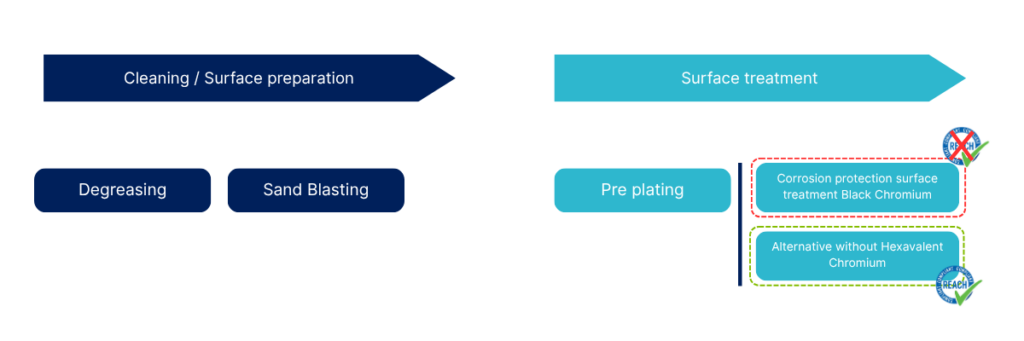
Replacement of Black Chromium - Qualification of a REACh compliant alternative

Figure 1 : Surface treatment layout of both Black chromium process and its alternative REACh compliant.

Technical validation of the “black chromium” surface treatment replacement

Addressing environmental and public health issues involves drastic changes for industrial companies; surface treatment processes containing harmful substances must be replaced.

Since the most critical property of these balancing parts is their mass integrity (the part must not lose weight due to generalised corrosion, or the aircraft balance could be affected), the alternative coating underwent rigorous testing.

From the various tests conducted for this qualification, the neutral salt spray test results (an accelerated corrosion test where parts are sprayed with salt water) and galvanic corrosion resistance tests are the most important. Those tests demonstrated that the REACH-compliant alternative meets all certification requirements. It can successfully replace the current Black Chromium plating and has been qualified (technically validated) on tungsten alloys since March 2025. 

Future challenge : Certification and Implementation (LBIP referential) of the black chromium replacement 

As several helicopter programmes are impacted by this change, a strategic stock of the product has been constituted to allow the continued use of the legacy Black Chromium process until 2026  ensuring a smooth transition in order to ensure business continuity.

The new process was tested for qualification with the current black chromium supplier, utilising an industrial bath already active for other applications. Working with the existing supplier is an opportunity to benefit from their specific expertise in the complex geometry of these parts. Documentation for this new process is available, and DOA certification (Design Organisation Approval), the official regulatory approval required by aviation authorities, is in progress. The challenge is now to qualify the process technically validated in the supply chain before full implementation. After this implementation, all of these parts will be REACh compliant. 

  • Share