The New Space Boom Meets Physical Limits
Once the exclusive domain of government agencies, access to space has fundamentally democratized with the rise of commercial New Space ventures. In just fifteen years, orbital activity has shifted into an entirely new dimension: the number of satellites deployed annually has surged thirtyfold from roughly 100 satellites launched in 2010 to over 2,900 in 2024, according to ESA DISCOS database records. This rapid upward trajectory continues to accelerate, driven by tumbling launch costs and aggressive satellite miniaturization.
The primary engine of this expansion is the deployment of Low Earth Orbit (LEO, altitude < 2,000 km) megaconstellations dedicated to global telecommunications. Unlike legacy geostationary spacecraft designed for decades of service, these smaller LEO platforms have operational lifespans capped at approximately seven years. Sustaining these orbital networks requires constant replenishment, creating an unbroken cycle of rocket launches and atmospheric re-entries.
This rapid industrialization raises a pressing question: as megaconstellations multiply amidst scientific uncertainties regarding their environmental footprint, how can ecodesign and Life Cycle Assessment (LCA) be embedded into space mission engineering?
1. Environmental Stakes: From the Launchpad to the Upper Atmosphere
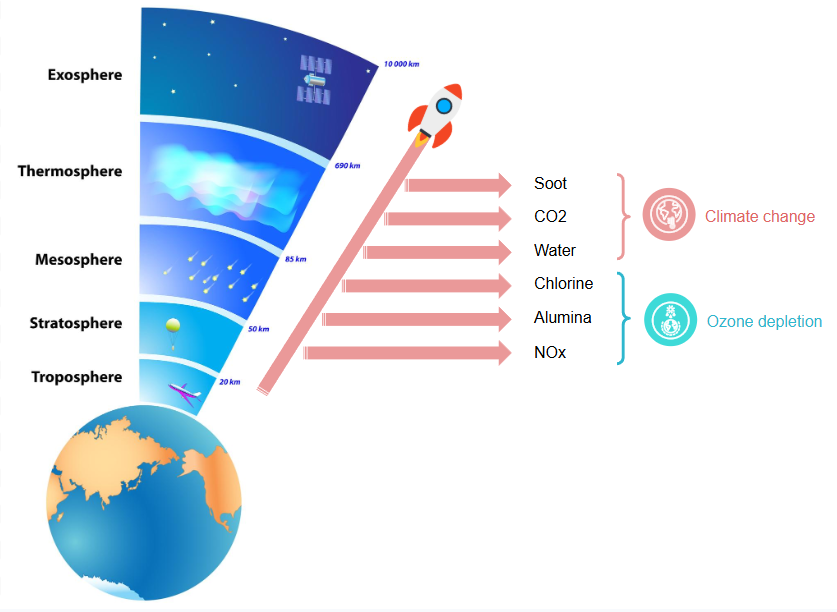
Orbital space is increasingly recognized as a finite environment, with orbital congestion in LEO creating severe logistical and safety challenges. Simultaneously, the sector’s terrestrial and atmospheric footprints are coming under unprecedented scrutiny. These environmental impacts span Earth and the atmosphere, driving both climate change and the depletion of the stratospheric ozone layer:
- Launch Emissions: A single heavy-lift launch can generate up to 2,700 tonnes of CO2 equivalent, while releasing chemically reactive substances directly into high altitudes including black carbon (soot), alumina, chlorine species, and nitrogen oxides (NOx). Emitted directly into the stratosphere and mesosphere, these compounds accelerate ozone depletion, an impact that remains difficult to quantify because high-altitude particulate behavior and fallout mechanics are notoriously hard to measure in situ.
- Propellant Selection: Choosing between solid, cryogenic, or hydrocarbon propellants involves critical environmental trade-offs, ranging from resource-intensive ground manufacturing processes to dense soot and particulate emissions during flight.
- Abiotic Resource Depletion: Manufacturing space-grade hardware requires rare earths, exotic alloys, and critical raw materials engineered to survive radiation, thermal cycling, and vacuum. The extraction of these specialized metals constitutes one of the mission’s primary impacts on mineral resource depletion.
- Cleanroom Energy Consumption: Machining, component integration, and final assembly take place in ISO-classified cleanrooms. Maintaining strict particulate control, temperature, and humidity requires continuous, energy-intensive ventilation, significantly increasing primary energy demand and indirect greenhouse gas emissions.
- Atmospheric Re-entry Impacts: At end-of-life, de-orbited satellites vaporize in the upper atmosphere. This thermal burn-up releases substantial volumes of submicron alumina particles that act as active chemical catalysts, driving further degradation of the stratospheric ozone layer.