
Business Resilience

Accelerate your resilience: Anticipate, prepare, respond and adapt

Don’t let a crisis disrupt your business. Our comprehensive approach starts with cyber resilience with proven expertise in crisis management and business continuity to ensure a secure future for your organisation. We can address all your risk management needs, which are not limited to cybersecurity.

Cyber resilience is a key component of business resilience. It represents an organisation’s ability to anticipate, resist, detect, respond to and quickly recover from cyber attacks or IT incidents.

The objective is to maintain the continuity of your essential activities, limit the impact even in crisis situations, and subsequently go beyond cyber resilience to achieve comprehensive resilience for your activities.

How?

Airbus Protect assesses the maturity of our customers’ resilience and protection solutions to manage risks beyond compliance. We help them to stand up when something happens by ensuring that their systems are highly resilient. To achieve this, our cyber consultants and experts are fully integrated into our customers’ teams, speak the same language and provide risk management and Cyber Resilience services:
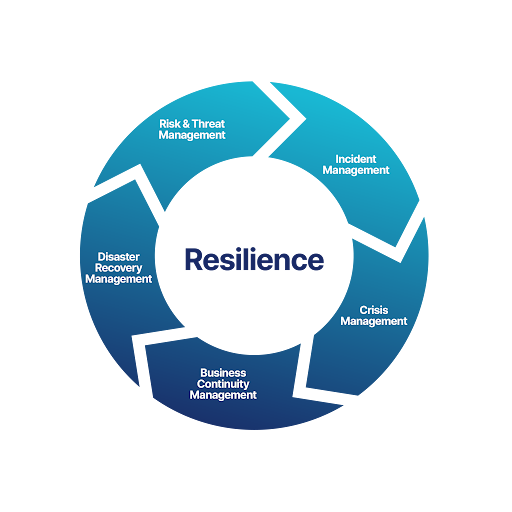
  • Risk and Threat Management: Risk scenario identification and assessment. Management of potential threats and their consequences leveraging Threat Intelligence information. 


  • Incident Management: Immediate operational response and escalation process in the event of an incident – defined as an event which disrupts normal activities without threatening the existence of the organisation, which can be managed locally and whose impact is limited.


  • Crisis Management: Crisis governance and exercises, development of crisis management documentation and coordination of activities. Strategic crisis response (high-impact event requiring a coordinated strategic response).


  • Business Continuity Management: Create Business Continuity Plans (BCP) to maintain essential activities. Trigger these plans in the event of a crisis. Create capacity for an organisation to maintain critical activities via dedicated organisation, roles, responsibilities, resources, procedures/BCP and testing/exercises.


  • Disaster Recovery Management: Support the restoration of systems, infrastructure, and operations to their normal post-crisis state.
resilience visual

By bringing together risk and threat management, incident management, crisis management, business continuity management and disaster recovery management into a single, interconnected and integrated approach, we help our customers to develop true cyber resilience, not only to recover from incidents, but also to anticipate them, adapt quickly and maintain critical operations whatever happens.

This comprehensive approach enables us to support our customers from start to finish, offering them a complete range of services for the successful cyber-resilience of their IT, OT and products.

The key question is how to translate this strategic vision into a practical culture within your teams.

That’s exactly what our Resilience Lab is designed to do. It is an interactive workshop focused on developing adaptability and embedding a culture of resilience that goes beyond technical skills alone.

Learn more about our Resilience Lab on page 60
Our vision is to push beyond cyber-resilience toward business resilience!

Cyber Resilience: Understanding the comprehensive vision of Airbus Protect

Anticipate, prepare for, and respond. Discover the 5 pillars of operational resilience to guarantee the continuity of your essential services and transform external constraints into collective strength.
Crisis Management: Insights from Airbus Protect Consultants

When facing a crisis, improvisation is not an option. Discover how to transform uncertainty into situational intelligence by applying crisis management principles and protecting the trust of your partners.
Business Continuity Management: Insights from Airbus Protect Consultants

Business Continuity Management: The continuity of your services is key to client trust. Discover our pragmatic 3-step approach to maintaining your critical activities and ensuring the sustainability of your organisation.

Team up with us to make resilience a strategic advantage!

Get in touch to discover how we can support you

What's new?

Filter
White Papers Supporting climate change adaptation and resilience in the aviation sector
Supporting climate change adaptation and resilience in the aviation sector

In this White Paper, our experts leverage predictive modeling to strengthen aviation resilience against climate change. While mitigation is vital, our study of the top 30 U.S. airports highlights a 14% rise in weather-related cancellations, demanding adaptation. This white paper provides actionable foresight into risks like extreme heat and infrastructure flooding. We empower stakeholders to identify critical thresholds and future-proof operations through industry-specific, data-driven insights.

Blog Collaborative Development of Complex Mechanical Systems
Collaborative Development of Complex Mechanical Systems

Case study of helicopter air conditioning system and MBSE integration Introduction The aeronautics sector is characterised by extremely strict performance, safety, and reliability requirements, making the development of new systems inherently complex. Onboard mechanical systems, such as helicopter air conditioning systems, shall not only meet rigorous technical specifications but also integrate flawlessly into an overall […]

Blog Cyber Security Architecture
Threat Modelling for Security Architects: Identifying and Mitigating Risks Before They Happen

As security architects, we’re responsible for laying the secure foundation for entire systems, encompassing software, hardware, networks, and critical processes. Our architectural decisions ripple throughout the system’s lifecycle, profoundly impacting not just performance, scalability, and maintainability, but, most importantly, the system’s inherent security. In today’s increasingly sophisticated digital landscape, building secure systems is no longer […]